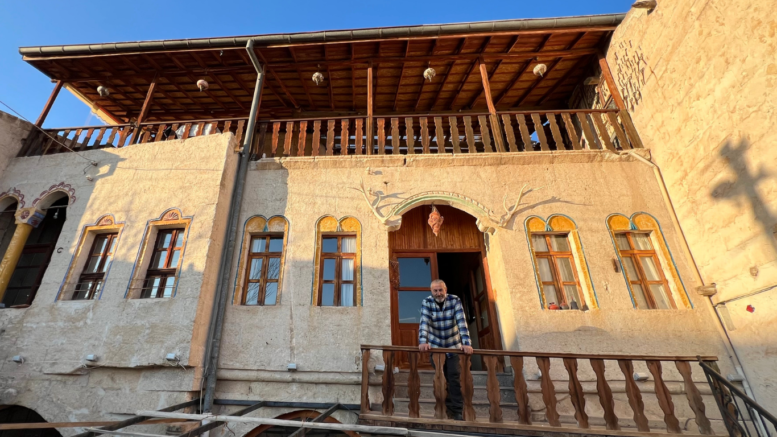
ÖZKAN KÜÇÜK
The most recent documented case of censorship in the film industry came to light when the Ministry of Culture and Tourism withdrew its production grant for Bingöl Elmas’ film “In the Trace of the Poetic Room” (Şiirli Oda’nın İzinde) and demanded its return with interest. This practice, which also saw Emin Alper’s film “Burning Days” (Kurak Günler) subjected to similar censorship in 2022, was this time applied to a documentary film still in production.
Whilst it has been reported that Elmas’ film, which documents the destruction taking place in Cappadocia, was rejected by ministry officials on the grounds that it was “political,” the fact that the official statement cited the film’s “incompatibility with the script in the application dossier” indicates that films are now also subject to “content control.” Meanwhile, Elmas, who has repaid the first installment of the production grant with interest, is also facing “economic censorship.”
Prompted by the recent banning of “Rojbash”—again by the Ministry of Culture and Tourism—and its exposure to similar censorship, we have come together as two directors for the Susma Platform. We discussed both the censorship targeting their own films and the increasingly frequent interventions against independent cinema in recent years, as well as what needs to be done.
Özkan Küçük: Shall we begin by discussing the period before the Ministry of Culture and Tourism demanded the return, with interest, of the production grant it had provided for the film “In the Trace of the Poetic Room”? Could you tell us a little about the film’s content, how it came about, and the process involved?
Bingöl Elmas: I live in Cappadocia. I witnessed how Mükremin Tokmak, a local historian fighting to protect Cappadocia’s damaged landscape, was making a very valuable effort here, all on his own. As a filmmaker, I wanted to publicize what he was doing, speak out about what is happening here and keep a record of it.
Cappadocia’s history is multi-layered and every corner is brimming with stories. With the establishment of the Site Directorate under the Ministry of Culture and Tourism, Cappadocia is undergoing significant change and development. Our living spaces are gradually shrinking; the region is being left at the mercy of tourism and commerce. Businesses are opening up in the very areas we use to sustain our local way of life. You go up a hill to watch the sunrise, only to find that the very next day, tickets are being sold. Ticket booths are being erected at the entrance to an area you visited simply because of its beautiful views. Almost every fairy chimney is now the site of a commercial activity, run either by the public sector or private enterprises. The public sector, which should be providing services, is instead engaging in commerce; you, as a citizen, are transformed into a potential customer wherever you go.
Making money from everything and everywhere is becoming the guiding principle. Moreover, you find it impossible to carry on with daily life. For instance, in Avanos, the riverbank is suddenly fenced off; the riverside, which ought to be open to everyone, is being leased to commercial businesses behind locked gates. As citizens, we struggle to understand for whose benefit and in what way the Waterfront Act has been bent.
They are driving heavy machinery into protected areas to clear a path. The fact that such practices are taking place in a region listed on the UNESCO World Heritage List and possessing special protection status is truly appalling.
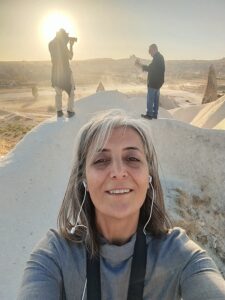
Bingöl Elmas
Amidst all this, there is one figure striving to preserve historical memory and cultural heritage, and working to raise awareness: Mükremin Tokmak. I, too, followed in the footsteps of his efforts and filmed all this. And as you know, we documentary-makers do not merely live where we go; we observe, collect and speak out. Mükremin Tokmak’s story was a very powerful one for conveying all of this.
Ö.K: So, what happened during the application process?
B:E: I submitted the film, along with all the details I have described, to the Ministry of Culture and Tourism. You know how the official rejection letter states, “The film you have shot differs from the script you submitted.” Well, in fact, all of these elements were included in the script I submitted with the application. As you know, they ask for something called a “concept note.” This text is a draft and constantly evolves during the filmmaking process. Indeed, by the very nature of a film, this is how it should be. This change often signifies progress for the film.
Although I was normally required to deliver the film within two years, I delivered it within a year to receive the second installment, even though I still had time left, because that money was rapidly losing value in the face of inflation. I sent the film and was contacted a long time later. I do not think this is normal either. When you consider the daily interest rate, I later realized what consequences this would have.
The first person to call said, “We cannot accept the film.” When I asked why, they said the film was deemed political and was therefore unsuitable. They suggested I discuss the matter with the directors. When I subsequently contacted the relevant official at the General Directorate of Cinema, I was told, “You are holding our Ministry responsible for the damage occurring in Cappadocia. You are making criticisms regarding our Regional Directorate. We cannot accept this film as it stands. We cannot support such a thing.” I then waited for the official letter to arrive. Three months after I submitted the film, the official letter reached me. The letter also stated that, apart from the script not meeting requirements, the film did not meet the technical specifications. Yet the film is, as it stands, in a condition suitable for submission to festivals. Furthermore, if I am required to meet the technical specifications, the fact that I was not given the time or the means to do so is another aspect of the issue.
During this process, I learnt that many filmmakers had experienced similar situations. I cannot name them as they do not wish to speak out. However, when their films were rejected, they resubmitted them after cutting certain scenes or adapting the film, and they were accepted in that form. I learnt that this is done in a highly systematic manner. Consequently, I realized that this is not an isolated incident. Content control, censorship and the imposition of self-censorship are on the rise in this sector. As you know, documentary budgets are more limited. So whilst TL 300,000 might not bankrupt anyone, having to repay a TL 6 million grant for a fiction film – amounting to TL 12–15 million with interest years later – is quite devastating. At the same time, this is something that will strike fear into the hearts of many filmmakers.
This situation is reaching a point where it could directly affect production, content, and what filmmakers are able to portray.
Ö.K: What was your budget?
B.E: They gave a total of TL 350,000. But they only made the first installment. The first installment was TL 175,000. They took back TL 270,000, including the penalty. I scraped together the money to pay it off, because interest was accruing.
Ö.K: So, have you considered initiating legal proceedings regarding this?
B:E: Well, to be honest, I did intend to, but at the moment, securing legal support requires significant financial resources. The cost of taking legal action is high. Also, these administrative cases generally tend to be decided in the state’s favor. As our faith in justice has, on the whole, been considerably eroded, taking legal action unfortunately does not seem like a viable solution to us. What happened to you with “Rojbash” is not actually that different. Could you go over the process again?
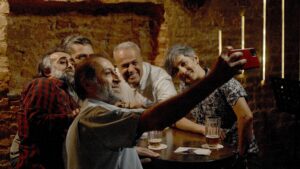
“Rojbash”
Ö.K: “Rojbash” tells the story of a group of Kurdish theater actors who reunite to perform one of their old plays 30 years later. It portrays, on the one hand, their own confrontations 30 years on, and on the other, their struggle against obstacles that remain unchanged or have simply recurred. It is actually an entertaining film, with a touch of irony and a touch of comedy. But at the same time, because it is a film that stands firm and does not back down, it naturally “did not go unnoticed.” When the film’s release was blocked by the refusal to issue a performance licence, we initiated legal proceedings against this. The court ruled in our favor and allowed the film to be shown. However, the Ministry’s lawyers appealed the decision, and the appellate court ruled in their favor once again, reinstating the ban. In other words, it brought the case back to square one. We are now awaiting the outcome of the appeal, but we are not very hopeful about it. It is highly likely that the Council of State will uphold the lower court’s decision. If that happens, we will naturally continue to challenge the ruling by appealing to the Constitutional Court and the European Court of Human Rights. All of this could take up to 10 years, of course…
When I submitted the film for classification, knowing about previous cases, I thought they might suggest I cut certain scenes, but instead they banned the film outright. So, did they ask you to make any changes to “In the Trace of the Poetic Room”?
B.E: No. I would not have gone along with that anyway. Because if I had thought that way, I could have submitted the film with certain scenes cut, but I did not. We are in this situation now because we chose to compromise rather than fight. I hear people telling me “something bad will happen to you” a lot, for example. All this will not go away if we just keep quiet, hide away in a corner and make no noise. My film has been banned; of course I am going to speak out against it. Moreover, this isn’t a personal issue; it is an issue concerning cinema. If the Support Board continues to censor films using this tactic, it will spell disaster for a whole host of filmmakers. This amounts to tampering with content, interfering with it, and imposing punishment.
Ö.K: In recent years, documentary cinema in particular has been heavily affected by this climate of pressure and interference…
B.E: Yes. I look at the programs of mainstream festivals, and the films of many directors I know are missing. Many films I know have been made are not on those lists. Take Antalya, for example: they carried out the worst kind of censorship and are carrying on as if nothing had happened. No apology, no redress, no action whatsoever. Nothing was done. At a certain point, filmmakers also carried on from where they had left off, saying, “Let’s not hold a grudge; these are our spaces too.” Yet, in reality, you cannot simply carry on from where you left off. You start to be weeded out. If your film takes a dissenting stance, you are weeded out. The preliminary juries do this, and the festivals do it too.
Ö.K: Are not the festivals, too, following a similar line by intervening in ways that align with the Ministry of Culture’s policy—a policy that has, in effect, become a form of state policy?
B.E: I think the festivals have aligned themselves far too closely. Not only do they lack an independent economy, but even if they did, they are constantly tiptoeing around the risk of something happening to them. For example, instead of issuing an open call, they now invite a director they have selected directly to the festival to minimize risks. The Istanbul Film Festival, meanwhile, removed the name of its documentary section from its program—supposedly so that all genres could compete together. How can such a disadvantaged form of production be made to compete on equal terms with other films? They also had a section dedicated to LGBTI+ themed films. They removed that too. They used to carry out such interventions in a more discreet manner. Now they are doing it right under our noses.
For example, was “Rojbash” ever screened at any festival in Turkey?
Ö.K: No, it was not screened at any of them. I submitted it to all the festivals, including the Istanbul Film Festival. None of them accepted the film.
“Bakur”
B:E: If the film does not have a distribution licence, you cannot submit it to festivals either, can you?
Ö.K: If you do not submit your film for classification, you can send it to a festival or hold a private screening, provided you include an “18+” warning. As you know, this rule was introduced after the “Bakur”¹ incident. As we applied for classification for “Rojbash” and were rejected, although that route has become somewhat more contentious, it was screened without any restrictions at the “Which Human Rights?” Film Festival and the Amed Film Festival.
All these interventions have really pushed us to a very serious stage. The chance for films to reach audiences through other channels is dwindling considerably. Distribution is a separate issue. It is even harder with documentaries, isn’t it?
B.E: For example, there used to be something called “town screenings.” We would travel from village to village and town to town, and there would be incredible, beautiful gatherings. But then all of that came to a halt. Because people no longer dare to organize events; they are not coming together. Everyone has shut themselves away at home. Organizing an event—let alone screening a film—has become something people are unwilling to risk.
Ö.K: On the one hand, there is an element of fear here, but has despair or a sense of helplessness also increased in the face of all these interventions?
B.E: It is like “learned helplessness;” there’s a feeling that we can’t change anything or make a difference, but I think fear is the more dominant emotion.
Ö.K: You have been working in the documentary field for years. How far back can you trace the beginning of this process?
B.E: I find it difficult to pinpoint an exact date. The government has always had an agenda to dominate the cultural and artistic sphere, but it was not achieving the progress it wanted in this regard. That is why it has been on the offensive for some time now. Today, we see that the film industry is also aligning itself with this pressure. Look at the TV series, screenplays, films and funding mechanisms. If you align yourself to this extent, it begins to define you.
When we look at the general political atmosphere, the fact that elected representatives are in prison, and that this tactic—previously applied to the Kurdish struggle—is now being applied to the whole of Turkey, has brought the vast majority face to face with the state.
Naturally, for people without a political background or stance, these are deeply unsettling and frightening things. On the other hand, what is courage, really? Something happened regarding my film—and beyond that, regarding cinema in general—and that is what I am talking about. Discussing and debating these matters is a necessity.
Ö.K: So, did you have any reservations in this regard during the filmmaking process?
B.E: As I made the film with support from the Ministry, I used to ask people, “Should your name appear in the film?” After all, you know what might happen in the country you live in.
On the other hand, the Ministry’s archive is also our archive. Those institutions have continuity. We will carry on too, and so the film must have its place in that archive. If the state is confident about the actions it has taken, we must be determined to show the outcome of those actions. I wanted to say, “You say ‘I am protecting Cappadocia,’ but look, this is the result.” Yes, “In the Trace of the Poetic Room” is a political film, but it is not propagandistic in form.
Ö.K: This shows that the extent of self-censorship has reached a stage far greater than we had imagined, doesn’t it?
B.E: Ten years ago, we were pressuring festivals to screen the film “Bakur.” Now, even talking about this feels very strange. This example alone actually shows how far we have regressed and how we have adapted to it. The fact that we now regard so many things we used to be able to do as mentally dangerous is, in my view, also a form of conditioning.
Ö.K: Even though it may seem as though little is being achieved, as you say, getting into the archive is important. The court ruling on “Rojbash” is another example of this. This ruling could serve as a basis for another film in the future; the courts might issue a ruling to release the film. Or it could act as a deterrent to those who censor films. Such moves are also important in terms of creating small openings.
B.E: During the “Bakur” period, we were able to respond collectively—by boycotting—to festivals’ attempts to refuse screening films without a work distribution licence. If that system had been firmly established, this process would probably have proceeded more quickly. On the other hand, this government has a certain method: for example, it does not ban abortion but makes it impossible to perform or access. Festivals are not demanding distribution licenses either, but they put so much pressure on festival directors that they simply stop selecting those films.
Ö.K: Even production grants can turn into a punishment…
B.E: I think they could apply this as a tactical maneuver too. For many people, particularly those receiving fiction film grants, this requirement to repay the grant with interest is devastating.
Ö.K: So what do you think the long-term impact of all this will be on cinema?
B.E: These are certainly not things that will happen overnight, but if we do not put up a proper fight, our closest example is Iran. But if we do fight back, it will not become this systematic. Now there is also a support mechanism for TV series. In TV series, scripts are changed on the spot out of fear of the Radio and Television Supreme Council (RTÜK). If, as an industry, you produce content in line with RTÜK’s requirements, the pressure will not stop; on the contrary, it will continue. And then we will all end up like state-run TRT…