CANAN COŞKUN
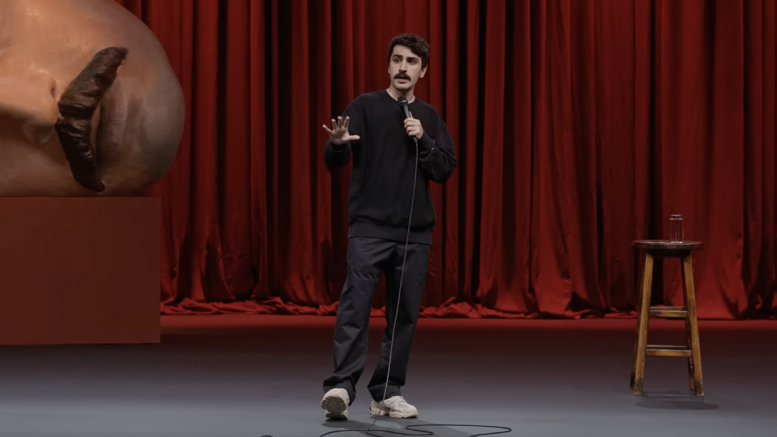
The first hearing in the trial of imprisoned comedian Deniz Göktaş on charges of “publicly inciting the public to hatred and hostility,” “insulting the president” and “praising an offense or an offender” over his stand-up show was held at at the 14th Istanbul Criminal Court of First Instance on 28 September 2026.
Due to the high turnout, the Istanbul 14th Criminal Court of First Instance held the hearing in the courtroom of the Istanbul 4th High Criminal Court. Strict security measures were in place around the courthouse and in the corridor leading to the courtroom prior to the hearing. Riot police armed with shields were stationed in the courthouse corridor. As the courtroom proved insufficient, the proceedings were broadcast via the judicial videoconferencing system (SEGBİS) in another room.
MPs from the TIP, the New Party and the DEM Party were also present at the courthouse to follow the hearing. The hearing, at which Deniz Göktaş was present in the courtroom, was also attended by a large number of bar association presidents, led by İbrahim Kaboğlu, President of the Istanbul Bar Association. The lawyer representing the plaintiff in the case, President Recep Tayyip Erdoğan, also attended the hearing.
Göktaş began his defense by stating that he had been brought from the Çorlu Karatepe High-Security Prison, known as a “well-type” facility. Göktaş explained that since 3 July, he had spent his days in a cell with no access to sunlight and without being able to communicate with any other detainees or prisoners; he noted that, due to high-security requirements—unlike in other prisons—he had been allowed to speak to his family on the telephone for just 10 minutes a week.
Pointing out that he had been in custody for 88 days because of four sentences he had uttered as a comedian during a stand-up performance at the Harbiye Cemil Topuzlu Open-Air Theatre, Göktaş said he had been held in a high-security cell for 22 days per sentence. Göktaş, who said he was proud to see that, as a comedian, his sentences carried such a powerful impact, added, “But as a citizen, I am saddened by my country’s record on freedom of expression.” Emphasizing that what had happened to him had strengthened his belief in his work, Göktaş said, “Once I regain my freedom, I will carry on with even greater enthusiasm and self-confidence. My only concern is that this case might dampen the courage of those taking to the stage and lead them to practice more self-censorship.”
Göktaş, who stated that he had recited the four sentences cited as grounds for his trial 197 times on stage prior to the video of the “Ölü Deniz” (Dead Sea) performance, continued as follows:
“I first staged the Dead Sea performance exactly as it is, using the same sentences, in Harbiye in October 2023. I staged it for the last time in June 2026, again in Harbiye. In other words, from the first performance to the last, I uttered these four sentences—which form the basis of the case—198 times, in front of more than 100,000 ticket-holding audience members across Turkey. Each time, they were met with laughter and applause. Thousands of people from all over Turkey did not see a single sentence that would warrant my imprisonment. The only complaint I heard during those three years was that people were struggling to get tickets. That, too, was due to tickets selling out quickly.”
The CİMER campaign
Göktaş, pointing out that the performance in question had been viewed and shared by millions of people within three days, and that programs had been broadcast and opinion pieces written about it, spoke of the smear campaign that began after it made the headlines, and said the following: “The first post I saw from this troll team was a ‘dictator joke’ shared by a high-follower troll account using the username ‘Şamil Tayyar,’ which became the subject of the charge of ‘insulting the president.’ They did not get the reaction they expected. On the second day, they tried to dampen the enthusiasm of those who had shared and embraced part of the İmamoğlu joke. However, this too failed to elicit the reaction they were hoping for. Users, apparently from the same troll team, were pleading with their teammates: ‘Let’s focus on the religious parts!’ and on the third day, they cut out the beginning and end of the joke in question, took it out of context, and shared it simultaneously from hundreds of accounts as ‘a comedian who insults religious values,’ launching a complaint campaign via CİMER (Presidential Communication Center).”
Emphasizing that these reactions were not organic, Göktaş explained that false reports had subsequently been circulated claiming he had fled abroad, and said, “On 22 June, I paid the conscription fee – nearly half a million Turkish Lira – to fulfill my military service obligation in 2027. I have never had any plans to live outside Turkey.”
Explaining that he visits friends abroad as soon as his tour ends each year, Göktaş continued, “At the moment, we can divide people aged between 20 and 35 into three categories. Those who have moved abroad, those trying to move abroad, and those trying to dissuade them from leaving so they will not be left alone in Turkey. I am in the third category. All my close friends have emigrated because they saw no future for themselves in Turkey. It was tragicomic to read the ‘he has fled abroad’ headlines alongside my friends, whom I had been trying to persuade to return to Turkey.”
“I was surprised even the police wanted to leave”
Göktaş, who stated that he cut his holiday short and returned to the country after an investigation was launched against him, described what happened at the airport as follows: “After getting off the plane, I went to the airport passport control and said, ‘There might be an arrest warrant out for me.’ We checked together and waited. An officer came to collect me, and we walked together to the airport police station. Whilst there, I greeted people at the airport who recognized me and wished them a safe journey. I was not taken by the arm, nor was I handcuffed. The officers at the station were surprised. ‘Deniz, why did you come back? Are you mad? If I were you, I would never come back,’ they said. We waited, laughing and joking, for the inspector. I was surprised that even the police wanted to leave the country.”
Göktaş explained that, despite turning himself in, the police had wanted to handcuff him; he said they gave up because he did not consent to it. Göktaş reported that, a short while later, an inspector from the Vatan Security Branch arrived and ordered him to be handcuffed again, noting that he was forcibly handcuffed behind his back. Göktaş explained that videos of him being handcuffed with his hands behind his back from the front, back and side were filmed at the Istanbul Police Headquarters, adding that in all of them he raised his head and smiled at the camera. He explained that this was why a video taken from a distance and from behind had been published. Göktaş stated that the police officers there had also asked him why he had returned to the country, adding that these officers, too, were dreaming of leaving Turkey.
Göktaş said that whilst in custody, he was taken to the forensic medicine department, where samples of his blood, urine, hair and fingernails were taken; he noted that, despite 88 days having passed, they still did not know the results of these tests.
“I was forced to meet with Kılıçdaroğlu”
Göktaş explained that when he was brought from the police station to the courthouse, he had to explain his jokes to the prosecutor, who had not seen his performance. He went on to describe the background to being brought to meet Kemal Kılıçdaroğlu whilst waiting in the courthouse corridor after his interrogation by the prosecution. Göktaş stated the following: “Despite telling him three times, firmly and clearly, that I did not wish to meet him, the inspector forced me to meet with Kemal Kılıçdaroğlu. As if being handcuffed behind my back was not enough, I was also forced to meet with Kılıçdaroğlu before the hearing. Kılıçdaroğlu said, ‘Why did you return from abroad? If I could, I would not stay here for a single minute.’ Unfortunately, he was the only one who said that amongst all the people I spoke to throughout this process. I did not want to meet with him whilst I was in custody so that he would not use me for publicity. As it was forced upon me, I spoke firmly, clearly and negatively. They even denied the conversation that everyone witnessed. The officers asked, ‘Why did you say let go of the CHP?’ Whilst I could not even see my lawyers, why was I forced to meet Kemal Kılıçdaroğlu at the courthouse with my hands in handcuffs? I am still wondering.”
Explaining that he had been re-arrested due to another joke from the performance – which had been cited as grounds for his initial release followed by re-arrest whilst in prison – Göktaş said, “I feel both the relief of someone acquitted of all charges and the anxiety of someone who has been re-arrested.” Göktaş then spoke about the jokes that had become the subject of the charges, referring in the indictment to the Constitutional Court’s rulings on freedom of expression and stating that, according to these, his words did not constitute a crime. Recalling that as a child he used to watch the sketches of Levent Kırca and Ferhan Şensoy broadcast on television, Göktaş said, “If they were to watch me now, they would find my words rather mild. The laws protecting freedom of expression haven’t changed since those days, but right now a comedian is in prison. What has changed are the politicians who cannot take a joke and are too fragile.”
Recalling that Fatma Betül Sayan Kaya, Deputy Chair of the AKP and a member of the Central Decision-Making and Executive Board (MKYK), had resigned due to her involvement in the funding crisis on the stock market, Göktaş said, “She is not offering any self-criticism, but she herself is seeking a pardon from the higher-ups. This only happens in a country run by people with dictatorial tendencies.”
“They wanted me executed”
Noting that there were 185 CİMER complaints against him, Göktaş said that most of the complaints were based on video clips from posts made by troll accounts. Stating that the complaints were not limited to videos, Göktaş continued as follows: “I looked through the complaints one by one to understand the statements that had offended the complainants. One of the 185 complaints stated, ‘He compares the Seljuk Empire to a salad.’ There is no such allegation in the indictment; I do not understand why the prosecution included it. Another one stated, ‘The individual’s Instagram follower count drops by 100,000 and then rises by 200,000. It could be an external lobby doing this.’ But there are two complaints that truly upset me, and I will quote them without any exaggeration. Two people from a section of the public whom I am alleged to have incited to hatred and hostility have called for my execution, saying, ‘I want him to be deported or, if you are to deal with this matter, executed as soon as possible.’ Another said, ‘Let him be executed in a country where the death penalty exists; thank you.’ The hatred within him is enough for the whole of the Middle East. He has taken hatred to a whole new level. You are a country without the death penalty, yet you have a comedian who deserves to be executed; in the other country, the death penalty exists, yet there is no criminal comedian. He is demanding the export of a comedian who deserves to be executed.
“Everyone who watched the ‘diver’ joke got it, but those who drew up the indictment did not. All right, you are suspicious of my intentions up to this point, but in the rest of the joke I am referring to Deniz Baykal, one of the symbolic figures of the headscarf ban. This point has been emphasized far too much. On social media, someone had said they would sue me over this joke. I do not know if he did, but I reckon he got the joke.” Göktaş, who recounted that he first told the “diver” joke in October 2023 and that a member of the audience came up to him and said, “I knew you would not say ‘hašema’,” and added, “To interpret it that way is forced and shameful. This is the accusation that bothers me the most. The fact that this sentence has been included in the indictment is a great stroke of luck for me. Because I am making a criticism of the secular people, the accusation actually falls apart on its own.”
Göktaş’s lawyer, Sinan Metin Aslan, also pointed out that the elements of the charges against his client were not present and requested an acquittal and release. President Erdoğan’s lawyer, however, stated that his complaints remained and requested to join the case as co-plaintiff, which the court accepted. The prosecutor, presenting their final opinion on the case, requested that Göktaş be sentenced in accordance with the indictment and released upon sentencing.
The court sentenced Göktaş to 7 months and 15 days in prison for the offense of “publicly denigrating religious values embraced by a section of the public” and to 11 months and 20 days in prison for the offense of “insulting the president.” The court acquitted Göktaş of the charge of “praising an offense or an offender,” for which he had been re-arrested whilst in prison on the grounds of a joke he made about the Dalton Gang. Taking into account the time Göktaş had spent in prison, the court ordered his release, subject to an international travel ban.
Background of the case
An investigation was launched on 29 June against comedian Deniz Göktaş following the publication of his stand-up show titled “Ölü Deniz” on YouTube. Göktaş, who was taken into custody on 2 July upon his return from abroad, was arrested on charges of “insulting the president” and “inciting the public to hatred or hostility,” and sent to Çorlu Karatepe Prison. Although a decision was made to release him on 28 August, he was re-arrested before he could leave the prison, this time on charges of “praising an offense or an offender” in relation to the same show; following the public prosecutor’s office’s appeal against the release decision.
In the indictment dated 3 September 2026 filed by the Istanbul Chief Public Prosecutor’s Office, it was alleged that the remarks made by Göktaş regarding President Erdoğan in his performance constituted insults; that the reference to a “fasting suicide bomber,” incited a section of the public to hatred and hostility; and that the statements regarding the Dalton gang constituted the crime of praising an offense or an offender.
The indictment, which sought Göktaş’s conviction on three charges, was accepted by the Istanbul 14th Criminal Court of First Instance.